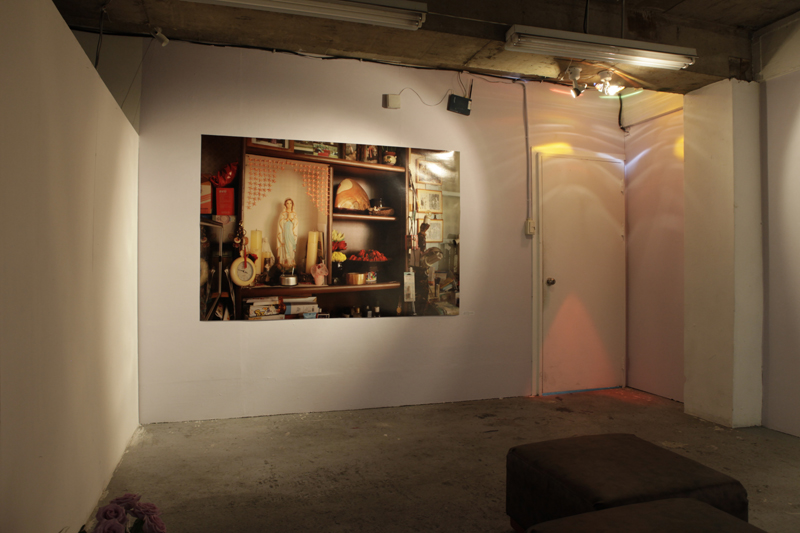
HOSPITALE is pleased to invite Kyoko Ebata, a Tokyo-based artist, as the 14th artist-in-residence, and to present her solo exhibition HOME as the outcome of her residency.
Ebata’s practice has long engaged with realities that are both intimate and often rendered invisible, such as ageing and death. Through works rooted in lived experience—including rooms inhabited by elderly people and the process of caring for her father at the end of his life—she has attentively drawn out universal emotions of love, loneliness and pain. At the same time, through performances such as washing Japanese national flags in launderettes, or experimental projects constructing a palm-sized nuclear power plant, Ebata has explored ways of responding to social and national issues, as well as anxieties surrounding the unknown, through her individual body and actions.
During the residency, Ebata developed new work in Tottori—a place where, since ancient times, all manner of things have drifted ashore. She conceived a narrative set in a near-future Japan, where a large-scale, compound catastrophe forces people to evacuate beyond the country’s borders. Within this setting, she focuses on those who nonetheless long to return to their homeland, shaping the project in the form of a science-fiction film script. In a post-apocalyptic world, how might new forms of life emerge, and how will the acts of living be shaped?
In this exhibition, the work is presented as an installation combining text and moving image. The former Yokota Clinic, the exhibition venue, is a building where practices of life and death once accumulated, and where human memories and everyday lives continue to overlap. HOME—a term that can signify a nation, a household, and a place to which one returns—takes on layered meanings when placed within this site, inviting each viewer to reflect on what constitutes a place of belonging for themselves.
Every morning, I hear news that goes beyond my imagination.
What is happening seems to be taking place in far, far away lands, yet it feels uncannily close.
In fact, reality itself feels like science fiction.
Before I can digest what is happening, the world shifts at a dizzying pace, leaving me confused about what should take priority.
While I am here, I hope to do something to help, to feel better about myself.
Yet, life goes on.
A strange sense of time, where a week feels like a day.
I guess I am at a stage of life where one can feel lost in time.
In the end, perhaps what matters most is the physical presence of the person closest to us.
The story is inspired by my personal life. I got engaged before the residency, and got married midway through the research and production period. We began a life in a small house in Tokyo.
Alongside the reality of a middle-aged couple, a near-future story is woven, with Tottori as its stage— a place where, since ancient times, all manner of things have drifted ashore.
In the story, a large-scale, compound catastrophe strikes Japan, forcing people to seek refuge beyond its borders.
And perhaps, as in any place and any era, there will be people who long to return to their homeland.
In a new post-apocalyptic life, what will living be like?
The exhibition space becomes a device that murmurs between reality and reverie.
<Notes>
Recently, I have begun to feel that things I once thought belonged to science fiction are becoming reality. I am startled by the sense of déjà vu in what is unfolding, while also feeling disoriented by developments I never imagined. At times, it feels as though the dreams and hopes we once held have betrayed us. These emotions seem to emerge in different forms depending on the environments in which people live, and I sense them in the blurred space between everyday life and the digital world.
In order to live our daily lives, we have to protect ourselves. Information overflows, and the issues we can empathise with continue to increase. Having found things to fight for, we become energised, but also exhausted. Sometimes we are pushed into situations where we must close ourselves off.
When I was invited to Tottori, I was overwhelmed by what was happening around me. Tottori is a beautiful place. In front of the breathtaking landscape, you feel as though it belonged to you alone. Life is rich with food from both the sea and the mountains. Perhaps influenced by the myths of the gods who created Japan, which I read as a child, there is a deep feeling of comfort that comes from physically sensing that people have lived there since ancient times.
Standing by the Sea of Japan, I began to understand the sensibility of those who live along this coast—the feeling that enemies might come from beyond the sea. Through this experience, it seemed possible to connect with ancient emotions, carried forward through fear felt in the body. During the Great East Japan Earthquake, I was on the twenty-first floor of a newly built office tower on reclaimed land along Tokyo Bay. The building had been designed to move in order to dissipate seismic energy. As it swayed in wide circles, like an amusement-park ride, I remember thinking how close it felt to colliding with the neighbouring building, and realising that its design had not anticipated the size of the earthquake.
Living in Japan has sometimes made me feel confused. There is a tendency to show little interest in politics or culture, to confuse criticism with complaint, and to refuse the responsibility of thinking for ourselves. Yet, as I continued to live with the constant fear of the next unforeseen earthquake, I began to understand the meaning of what are often described as Japanese virtues. Over long periods of time, even if all our houses are destroyed, even if the land itself becomes contaminated, we are training ourselves to close our eyes and keep moving forward.
In Tottori, I spent about a month in a house that was once a brothel, and found myself troubled by my own vivid imagination. Feeling fear in that place forced me to confront aspects of myself that I would rather not acknowledge. Even as I try to find a way to communicate with others and express concern about the rise of xenophobia, I recognise a kind of prejudice within myself, taking the form of fear. I really hated myself. This felt closely connected to what has been described as the fragmentation of liberalism, and I sensed how deeply rooted this problem is. Around the same time, I reflected on my own life—having married at an age when I can no longer have children—and felt the difficulty of locating emotion and sexuality within capitalism, labour, and body politics.
There, I reacknowledged that conditions resembling the former brothel persist even today, and that the issue of sex workers’ rights is deeply connected to my own life and fundamentally tied to the question of how a nation is founded. Yet, in a world where assisted dying is becoming possible again in new forms, and reproduction can be outsourced, I do not yet have words for the whole thing.
It reminded me of a moment when I complained to my partner, “I can’t cook every day” even though I wanted to.
After the initial outcry, and after moving through discussion, effort, habit, resignation, and resolve—the path that many people must have walked—life gradually began to settle. Little by little, some things have stopped bothering me too much. I guess starting anything new is usually difficult, after all.
Still, I felt grateful for the ability to make noise when I am in pain. I am lucky. I came to believe that what I must do is not to close my eyes or look away, even when I cannot yet articulate issues in words.
Through this work, I would like to turn what I fear and what I struggle to understand, into a story in order to cultivate a sense of objectivity, to conduct a kind of rehearsal, and to imagine myself surviving within it.
I do see light here and there. I am determined to nurture them.
Recently, I’ve been taking photos of couples passing by.
I tried to think about why I was attracted to couples now. Of course, I have a sense of crisis about the current social situation, where people are becoming morbidly sensitive about their privacy, but the biggest reason might be that I recently had opportunities to go to so-called “dating spots” that I’d never been to before. The main reason must be that I finally have a boyfriend who I’m thinking of marrying.
In the beginning, we went to places like Skytree, Tokyo Tower and the aquarium. There were not many middle-aged couples at these places, so the young couples looked beautiful. Before I knew it, I had become a middle-aged woman.
I also feel a sense of admiration for couples who have been together for a long time. Of course, there are probably all sorts of things going on in their relationship. But because I can’t have what they have, I can’t take my eyes off the illusion of their happiness.
I don’t really know why I didn’t meet my future husband a little earlier. Actually, I do know, but I’ll say I don’t know.
But I think the fact that my father died was a big factor. When I thought about the reality of being alone after my mother died, I became extremely scared.
However, why it took so long is still a complete mystery. From childhood, I thought that when I grew up, I would get married, have children and have a family. I had even decided on the names of my children.
We decided not to have a wedding ceremony. I thought that a Japanese-style wedding would be nice, so that my father would look good even in a wheelchair. The wedding was to show my father, but he is no longer here.
So, I’m still a bit of a novice, but I’m working so hard. In the past, I might have refused to have my photo taken at a photo spot, but now I’m trying to make my partner’s favourite potato salad, but my skill does not seem to get any better, and I gave up on making fried chicken at early stage. I can’t beat a take out. I feel bad.
I guess it’s a two-way street, but I wonder why men are such mysterious creatures. We’ve led completely different lives, so it’s a continuous surprise. But men are cute, aren’t they?
I can see that the poor guy is also making a huge effort. After two years, he finally confessed that he doesn’t drink hot coffee or tea. It seems that cold bottled barley tea is best for him. So I don’t bother making espresso because I can imagine that he would say it was ‘muddy water’.
He doesn’t cook, but recently, when he cooks something from a recipe book, it tastes better than mine.
While the price of a rice ball has risen from 100 to 125 yen at Seven Eleven and we are busy surviving our daily lives, wars have been going on somewhere in the world since the beginning of history. Are wars started to protect our loved ones?
Media wars that fuel insecurity. In the midst of the confusion between the real and the virtual, I had to do something to say I am against wars, even if it is a tiny action. So one day I have decided to go to Taiwan where there is a lot of concern about the Chinese unification of Taiwan.
The state of being able to wash the Japanese flag in a laundrette and talk about the past and future wars with strangers passing by is “normal” must be a very peaceful state. I would like to cherish this moment.
The exhibition ‘Fireworks and Bombs’ will feature the new work ‘Washing the Hinomaru (Taiwan)’ and the street snapshots of ‘Lovers’, both of which explore the themes of love and violence. It will also feature the martial arts photographs taken by the young photographer group REKREATIF at the workshop Nu’udar Ema; How do you cope with being a human? held in East Timor in 2021. Martial arts in East Timor have become a social problem as they have become a gang culture. The workshop brought together two rival gangs for a match.
The performance ‘Washing Hinomaru’ is a performance that has been held in Taiwan since 2013, after the Great East Japan Earthquake. The performance involves repeatedly washing, drying, ironing and folding multiple Japanese flags in the washing machines at laundromats around town. The Japanese flags are hung out to dry on clotheslines and also function as an exhibit, and the flags and the act of washing them act as a mirror, and there are various interpretations of the work depending on the viewer. Ultimately, I want to go to all the countries that Japan has invaded, and I have performed this work whenever I have the chance.
This time, I was watching the ongoing wars in Gaza and Ukraine, and I felt that I had to do something, but I didn’t know what to do, so I went to Taiwan anyway, thinking that I had to do something.
Even though I had been to Israel and had had the opportunity to speak directly with people from Russia, Ukraine and other conflict zones such as Myanmar, I felt that the information I was receiving was being overwritten in my mind.
One day, when I met a friend from Hong Kong who was visiting Japan, I was very moved when he said, ‘I’ve lost my country’. He was a university professor in Hong Kong, and he was a very gentle person who didn’t make political works. He said that it was difficult to live in Hong Kong, and now he lives in the UK. I was made keenly aware that democracy cannot be maintained without effort. He told me that Taiwan might end up like Hong Kong, and that really got me thinking. I felt like I had to go there soon, or I might not be able to film there again. I showed my work “Washing the Japanese Flag” in Hong Kong a long time ago, but I don’t think I could do that now.
Also, I have a good friend who has been working in Shanghai for about 10 years now, and while I was thinking about going there one day, the coronavirus hit, and things started to look more and more difficult politically, and I was starting to regret it. Anyway, I felt a sense of crisis that the world was changing rapidly while I was taking it easy.
When I thought about it later, I realised that Hong Kong and Taiwan are in different positions, and there was no need to panic. Also, the people of Taiwan were all very level-headed, and they said, ‘The people at the top are to blame for the past. What’s important now is to do what you have to do and live your days in a calm and collected way. But you should definitely vote.’
I was also able to speak to people from China. While I was able to talk to them and feel the clear differences in education of each country, I managed to feel little self-satisfied, but even when I watch the news and know that it’s a media war, I feel very sad.
That said, war has been going on since ancient times, and various feelings continue to be passed down from generation to generation. As a Japanese person, I’ve been casually assuming that Taiwan likes Japan, but for the Taiwanese people, what is important now is the US and China, and ordinary people enjoy K-POP, so Japan’s presence is something of the past. Even so, what Japan did to Taiwan has not been forgotten, and those who had feelings of affection for Japan have also suffered discrimination, so the feelings are complex. In particular, the way the Japanese military treated the indigenous people is something that is repeatedly discussed in Taiwan as the country establishes its national identity. When I mentioned this to a Taiwanese person, they consoled me by saying, ‘The past is the past, and now we are both earthquake-prone countries, so we are helping each other out.’ I was so moved.
Although there are some Japanese people who are xenophobic or who harbour a desire for something special about the Japanese that foreigners cannot understand, most Japanese people have completely forgotten about World War II. And by doing so, we have gained various benefits. In particular, we lost the war, and being the aggressor must be painful. There are various cases, but that is perhaps what war is like. The perpetrators suffer from trauma and keep quiet, hoping for oblivion, while everyone continues to repeat the propaganda as victims.
Why do people still get drawn into war? It is important to remember the past, but it is equally important to move forward and build and maintain peace.
Is there any way for the people of Israel and Palestine to forget the past and talk to each other? Through my work, I wanted to encourage people to reconsider the past wars and to think about how to turn them into museums, and to find ways of communication for people with diverse opinions. Is it really only the ‘higher-ups’ who are to blame? Is there nothing we can do?
Washing the Hinomaru flag at the laundromat and being able to talk, even if only a little, with people who don’t know about the difficult past wars is a ‘normal’ state of affairs, and it may be that this is a very peaceful thing. I want to cherish this state of affairs.
August 2024
[Documentation Video]
日の丸の洗濯:あれは花火か?爆弾か? Washing Hinomaru: Fireworks or Bombing? 2024- デジタルビデオ digital video 33:18:23
『日本人は礼儀正しくてやさしいのに、なぜ台湾を侵略したのかは不思議です』 『また侵略してこないですよね? 』”I have a question: Why did the Japanese start the war at that time while they were all very nice ?” “The Japanese won’t do it again now, right?” “我有一個疑問,爲什麽當時的日本人都很和善,現在,現在的日本人應該不會了吧?”
『私が一番怖いのは、戦争も嫌いだし、暴力も反対だけど、もしその場にいたら、周りに流されて暴力を振るってしまうんじゃないかということです』 “What I fear is, although I hate war and against violence, if I was in that situation, I would probably be swept away and do it. “我最擔心的是,雖然我痛恨戰爭,反對暴力、如果我身處那種境地 我很可能會被暴力沖昏頭,做出這種事。
『もちろん戻して欲しい、台湾を。あ、中国を。一体になってほしい。でも戦争を起こすのは嫌。平和な方法があれば、戻して欲しい』 “Of course, I hope Taiwan to come back to China.But I don’t like to start a war. If there is a peaceful way, I want Taiwan to be back.” “我希望台灣能回歸于中國。“我不喜歡戰爭,如果有和平的方式解決是最好的。”
『中国人的観点から見ると、中国は1949年に中華人民共和国が成立して以来、他の国に侵略をしていないです。中国から喧嘩を売ることはないけれど、やられたら絶対やり返します』”From a Chinese point of view, China has not invaded since becoming the People’s Republic of China in 1949. China won’t start a fight, but if it gets attacked, China will fight back. ” 從中國的角度來看,自從中華民國於1949年成立之後,中國也沒有入侵台灣。中國不會開戰,但是如果真的有打仗的話,中國也不會坐以待斃。
『もしその時が来たら、銃撃戦が始まるでしょう』”If the time comes, we’ll start a battle.” 如果到時候發生了,還是會開槍。”
『個人的には平和は社会的な平等です。それが実現できなければ平和ではありません』 『(それでは)まだどこにも平和はありませんね』“I think peace means social equality.If that cannot be achieved, then there is no peace.” “There is no peace anywhere then.” 我認為和平就是社會平等如果不能實現,就沒有和平。那麼任何地方都不會有和平。
“The quest of Kyoko Ebata: Washing Japanese Flag; Washing Japan”
Kazhisa Kuwahara
In early spring, the air in Taichung City, Taiwan, is dusty. Six Japanese national flags, hung on ropes used as clotheslines, dance in the wind. “Washing Hinomaru”, a performance by Kyoko Ebata has begun.
Two women speed through Taichung City on a scooter: a local interpreter driving, while Kyoko Ebata, who came from Japan, sits in the back. IKEA bags bulging with Japanese flags rest at their feet as Ebata grips her camera gear. It’s awkward, yes, but together they roam the city in search of a laundrette for the performance.
From 15th to 26th March, Ebata performed her flag-washing performance in Taichung and Tainan, Taiwan.
Here is how it works. Ebata brings a large number of Japanese flags to a laundrette in the city, washes them in washing machines, dries and irons them. She repeats this process while interviewing people passing by.
A sense of crisis about a new war
Over the years, she has exhibited this project in Tokyo, Mumbai, Hong Kong, and Vienna. One day her friend from Hong Kong told her that Taiwan may become like Hong Kong. That prompted her to bring the project to Taiwan. Fluent in English after spending most of her student days in Europe, she has many overseas friends. He moved to the UK following Hong Kong’s pro‑democracy crackdown.
“The thought of what would happen if a crisis were to occur in Taiwan made my chest feel heavy”prompting her to launch the project immediately.
Although she typically negotiates with launlette owners in advance, time constraints led her to secure permission on-site through guerrilla-style.
“I would like to apologise to people from countries that have suffered from the war, even if I try to hear about their experiences, they have almost all passed away—so I wanted to bring out the voices of ordinary people through my performance.”
She also points to the current situation in Palestine and Gaza: “I feel a sense of crisis because a new war is emerging.”
“This is why I am doing this: in the hope that a peaceful state—where the Japanese flag can be washed like this—will continue.”
“The reactions of Taiwanese viewers were warm towards Japan: ‘Some people showed me photos from their trips to Japan.’”
“A woman asked me if I was a YouTuber” I explained that I’m an artist. I moved around every day and talked to many people. A man told me that while there are many vacant houses in this area, it’s not because the owners have passed away, but because they fled abroad out of fear of a Taiwanese emergency.’
There were also voices from young people; “Taiwan has an army and is also striving in IT, so it’s different from Hong Kong,”, “The problem is the people in power” and “I can’t imagine killing people in a war, but I’ll think about it when the time comes.” The only critical comment about Japan came from a man living next to the laundrette, with whom we could have a long conversation: “Japanese people are polite, so why did they invade?” This statement left a deep impression on me.
In the future, she “wants to wash the Japanese flag in every country where the Japanese army fought during World War II.”
You are not Japanese
Ebata studied art in the UK, has exhibited internationally, but why ‘wash the Japanese flag’ now? The first performance dates back to 2013.
An art festival was organised in Koganei, turning a Tokyo suburb into an exhibition space. There, a laundrette was prepared for Ebata to show her work. It was “after the Great East Japan Earthquake, so I wished I could wash Japan.”. That led to the idea.
At first, it was about “washing Japan contaminated by radiation”. At the same time, she felt ”The people of Fukushima are victims, and I am the perpetrator.”
“I somehow knew that nuclear power plants were dangerous, yet I was working in a clean office in Tokyo with air conditioning, without questioning it.”
The focus of her washing shifted from radiation to Japan itself. Art critic Tomoki Koganezawa described the sudden appearance of a group of Japanese flags in a quiet residential area in Tokyo as “decontextualising the space.”
“I washed the Japanese flags-most people pretended not to notice.” The scenes in the documentation video are comical.
But there were also people who raised their voices, saying, “You’re not Japanese!”, while older viewers praised the act as “patriotic.” A comedian, Torihada Minoru, even left a performance pamphlet.
As reactions reveal, “Washing the Hinomaru” is a simple catalyst that brings hidden, fundamental thoughts to the surface—and that is precisely its power of this work.
To conclude, I asked Ebata a direct question “What does a country mean to you?”. She said “I was born and raised in Bunkyo, right in the centre of Tokyo, and I never questioned being Japanese. As a child, I thought I was in the centre of the world. When I was in school, I was one of those girls who told bullies to piss off. My classmates called me “Eba-police.”*1
However, when she went to study abroad in Europe from high school, she met people from diverse backgrounds, and her perception was changed.
Don’t define yourself
She says, “Compared to Europe, there are surprisingly few people in Japan who talk about politics.’ ‘On TV political programmes, comedians insult someone while assuming that there is a powerful god called “society” and encourage viewers to stop thinking. I find that repugnant.”
During the interview, I noticed that even while discussing sensitive issues, Ebata always had a joyful smile, like a child who had just experienced something wonderful. Her smile left a distinct impression as much as the interview itself.
As a mentor for young artists at the Arts Council Tokyo, a public organisation, Ebata keeps a humble attitude, saying “I still have much to learn.”.
“Love for one’s country is not the same as glorifying it. As an artist, It is my job to not define myself-to go beyond those boundaries.”
If you really want to convey something to others, it is better to approach them with humour and allow them freedom of interpretation, rather than cornering them with logical arguments.
Ebata’s “Washing the Japanese Flag” reminds us of something important we tend to forget in our daily lives.
—
*Photo caption
A performance of “Washing Hinomaru” in Taichung City. The top-right photo shows a conversation with a man from the neighbouring laundrette about past, present, and future wars while the flag was drying.
*1 “Eba-Police” was name of a robot in a robot TV show for children in the 80’s
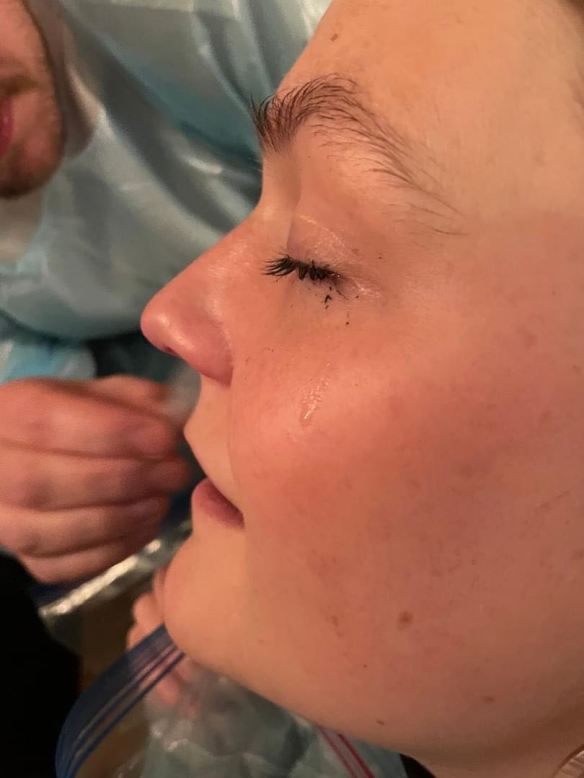
TEARS wanted! I am dead serious. Please give us help (and your bodily fluids)! For our project, <<Making plum pickles with tears (work in progress)>> we need to make salt out of tears, and make pickles from plums from our garden. Any suggestions for the methods will be great, so far, onion is not working so much, and I don’t want to punch anybody.
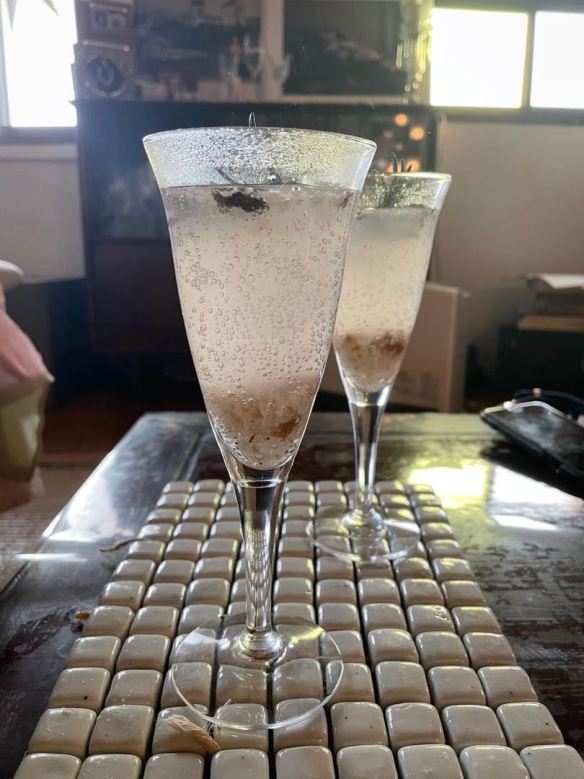
The refreshment made by Kana Kimura with half a century pickes of my grand mother. 木村さんが祖母の50年ものの梅干しで作ったウェルカムドリンク。ローズマリー、桜の花のフレーク、麹などが入っています。今まで体験したことのない繊細でフレッシュな味でした。
On the occasion of the screenings of “The Desert Moon”, a work about Ebata’s father’s end-of-life care at the House of Ebata, Ebata’s grandparents’ home, a talk by Viktor Belozerov and a participatory performance with Kana Kimura and Mako Fukuda were organised.
In “Making plum pickles with teas”, we wanted to practise remembering the power of life and humour in the midst of mourning through the ritual of ‘eating together, crying together, making salt from the collected tears, and using the salt to dip new plum trees in the garden’ with half-century-old dried plums found in the barn at the House of Evata. We harvested the plums from the garden in June and are currently looking for a way to collect as much of the tears as possible.
We also had a talk “Anti-war vacation: life and death in art and politics of Russia” by a Russian researcher, Berzoerov, on contemporary art in Russia. Since the Ukraine Invasion, the world has become increasingly divided. From the ongoing division to the division with the past, the desire to forget the past and many other complexities. We were told that currently, interaction between researchers is also hindered. I think it is important for others with different ways of thinking to get to know each other better in order to coexist.
I am against war, violence, everything, but even asking a sick father to live can be violence. Violence is lurking in all of us. I hope that when we realise, when we have the chance, we can have just a little bit of courage and make choices that will reduce the number of people who suffer, even if just a little bit.
The dialogue with Viktor began when Russia invaded Ukraineand Viktor invited Japanese artists to write anti-war statements for a letter campaign called “Letters for Peace”. Does loving someone also mean that you will lose that person eventually? Do we start a fight to prevent the loved one from getting hurt? We don’t really know what the future holds, but we believe that now we can love more people and understand each other more.
*ビクターさんは国外からオンラインで参加になり、トークは英語で行われますが、日本語でのサマリーや通訳のサポートを行います/ The talk will be held in English. Language support for Japanese will be provided on an as-needed basis.
House of Ebata was the home of Ebata’s grandparents. A few years ago, pickled plums that seemed to have been made by Ebata’s grandmother some half-century ago were found in the storage. Dried plums have long been a popular preserved food and food medicine. Preserved food is an ongoing living memory and a family history that is passed on. In screenings for the film “The Desert Moon”, which is about Ebata’s father’s death-watch, with Kana Kimura and Mako Fukuda’s participation, we used the pickled plums in the ritual of “eating them together, crying together, making salt with a large quantity of forcibly collected tears, and using the salt to dip the newly grown plums in the garden tree”, so that even in mourning, we can practise not forgetting to find strength in life and a sense of humour.
“The idea of preserving food without allowing it to spoil is itself an attempt to ‘resist death’. Waking up the dried plums in our bodies, which have been sleeping for a long time in a dream, defying death, is an act of synchronising the dried plums with our time axis and making life and death in continuity. The dream is then activated by our tears and crystallised into salt. Salt is indispensable for living beings, but at the same time it can kill all living things, if we use too much of it. By using the salt, our bodies meet the plum tree, which bears new fruit again this year, and together we pass it on to the next generation.(Kana Kimura)”
*The pickled plums were tested by Food Microbiology Centre Inc. and found to be safe for human consumption.
Chopped onions and had traditional funeral soup with chili pepper to cry and made curry in the end! 玉ねぎと三重県のお葬式に伝わるとんがらし汁(辛さで泣くのだそうです)で泣いた後、泣くのに使った素材を使ってカレーを作りました。やさしい味のカレーでした。 https://houseofebata.wixsite.com/inforeceipt: ume-boshi, malt, ginger, sakura flower flakes, rosemary and sparkling water take aways
Viktor Belozerov is an independent researcher. Graduated from the Art History Faculty of the Russian State University for the Humanities (Moscow). Created the educational project Gendai Eye, which aims to promote contemporary Japanese culture in Russia. Currently the lead researcher of the Japanese Laboratory J100R, which focuses on ideas about contemporary Japanese art in Russia from the 1920s to the present.
江幡京子|Kyoko Ebata
アーティスト。ゴールドスミス卒。日常で目にする様々な事柄をテーマにそこで生活する者の目線から時代を表現する。現在はプロジェクトスペースHouse of Ebataを運営しつつ、国内外で発表している。
Kyoko Ebata is an artist, graduated from Goldsmiths’ College. She expresses the times from the perspective of a person living in everyday life. Currently runs the project space House of Ebata, while exhibiting widely.http://kyokoebata.com
Lives and works in Germany. Runs the webzine ‘vulnerable people‘ and the Zine event ‘ZINEFEST Leipzig’. She pursues her interest and activities in intermediary communities, including involvement in the community space ‘Das Japanische Haus e. V.” in Leipzig. https://vvulnerablepeoplee.wixsite.com/website
Kimura has graduated from Fine Art BA, Iceland University of the Arts. From a cultural anthropological perspective, the artist observes and produces the transition of internal and external relations. Focusing on transience and the dynamic movements that take place there, she attempts projects and workshops, which she calls ‘ritual production’. She run a web magazine “vulnerable people” https://kanakimura.wixsite.com/kanakimura