
HOSPITALE ギャラリープログラム 2026
江幡京子「HOME」
HOSPITALEでは、レジデンス・プログラム第14回アーティストとして、東京を拠点に活動する江幡京子を招聘し、滞在制作の成果として個展「HOME」を開催します。
江幡はこれまで、高齢者が暮らす部屋や実父の看取りなど、老いや死という身近でありながら不可視化されがちな現実に向き合い、そこに寄り添いながら、普遍的に存在する愛情や孤独、痛みを作品として掬い上げてきました。また、「コインランドリーで日章旗を洗濯する」パフォーマンスや、手のひらサイズの原子力発電所をつくる実験的プロジェクトなどを通して、国家や社会が抱える課題、そして未知なるものへの不安に対し、個人の身体と行為から応答する表現を展開してきました。
今回の滞在では、太古の昔からさまざまなものが流れ着いてきた鳥取という土地を舞台に、新作の制作に取り組みました。近未来の日本で広域複合巨大災害が発生し、人々が国外への避難を余儀なくされた世界を設定とし、それでもなお故郷へ戻りたいと願う人々の物語を構想、SF映画のスクリプトとしてまとめ上げました。ポストアポカリプスの世界において、新たな生活はどのように立ち上がり、生の営みはどのように形づくられるのでしょうか。
本展では、物語のテキストと映像によるインスタレーション作品として発表される予定です。
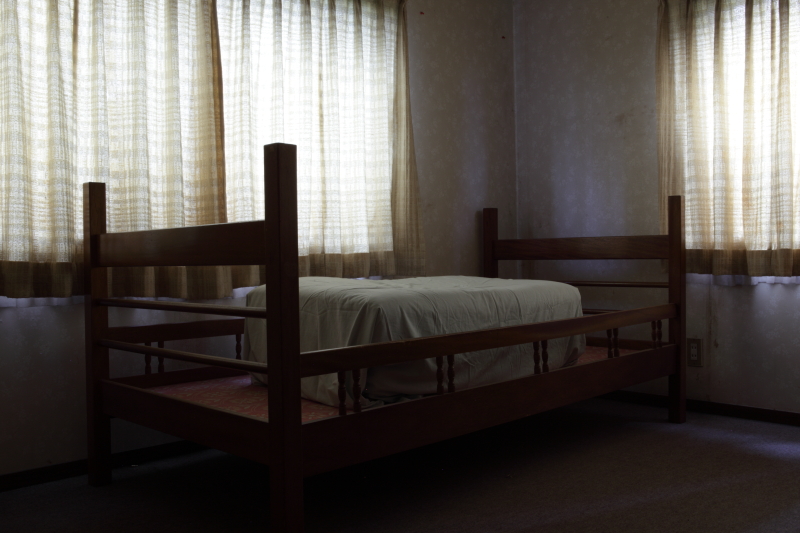
展示会場となる旧横田医院は、かつて生と死に向き合う営みが重ねられてきた建物であり、人の記憶や生活が重なり合う場所でもあります。「HOME」という、国家であり家庭であり、帰る場所でもある多義的な言葉が、この場所に重ね合わさることで、一人ひとりにとっての拠り所の在り方を問いかけます。
*展示の記録 Documentaiton: https://kyokoebata.com/2026/03/homehospitail-project/

HOSPITALE Gallery Program 2026
HOME, Kyoko Ebata
HOSPITALE is pleased to invite Kyoko Ebata, a Tokyo-based artist, as the 14th artist-in-residence, and to present her solo exhibition HOME as the outcome of her residency.
Ebata’s practice has long engaged with realities that are both intimate and often rendered invisible, such as ageing and death. Through works rooted in lived experience—including rooms inhabited by elderly people and the process of caring for her father at the end of his life—she has attentively drawn out universal emotions of love, loneliness and pain. At the same time, through performances such as washing Japanese national flags in launderettes, or experimental projects constructing a palm-sized nuclear power plant, Ebata has explored ways of responding to social and national issues, as well as anxieties surrounding the unknown, through her individual body and actions.
During the residency, Ebata developed new work in Tottori—a place where, since ancient times, all manner of things have drifted ashore. She conceived a narrative set in a near-future Japan, where a large-scale, compound catastrophe forces people to evacuate beyond the country’s borders. Within this setting, she focuses on those who nonetheless long to return to their homeland, shaping the project in the form of a science-fiction film script. In a post-apocalyptic world, how might new forms of life emerge, and how will the acts of living be shaped?
In this exhibition, the work is presented as an installation combining text and moving image. The former Yokota Clinic, the exhibition venue, is a building where practices of life and death once accumulated, and where human memories and everyday lives continue to overlap. HOME—a term that can signify a nation, a household, and a place to which one returns—takes on layered meanings when placed within this site, inviting each viewer to reflect on what constitutes a place of belonging for themselves.

想像を超える出来事が遠いけれど近く感じる場所で起きている
まるで現実がSFのように感じることがある
驚きを咀嚼する前に目まぐるしい早さで世界は変わり
もはや何を優先すべきなのかわからなくなっている
何かしなければと思いながらも、日常は続いていく
1週間が1日のように感じられる不思議な時間の感覚は増すばかりだ
結局大事なのは自分の一番近くにいる人の感触なのかもしれない
東京郊外の深い緑に囲まれた小さな家で始まった新婚生活をモチーフに
太古の昔からさまざまなものが流れ着いてきた鳥取を舞台に近未来の物語が紡がれる
その物語では日本に広域複合巨大災害が起き人々は国外へ避難せざるを得なくなる
そして、いつの世でも故郷に戻りたいと思う人はいるのかもしれない
ポストアポカリプスの新しい生活では生の営みはどのように作られていくのだろうか
展覧会場は現実と夢想を呟く装置となる
<作品の背景>
最近、SFだと思っていたものが現実になってきているような感覚を覚えます。現実の既視感に驚きながらも、想像もしていなかった展開に戸惑っています。夢や希望だったものに裏切られたような気持ちになることもあります。そんな感情が人が生活する環境ごとに様々な形で立ち現れて来ているようで、出会う人々、そしてコンピューターのスクリーン越しに感じられます。
同時に毎日を生きていくために、わたしたちは自分を守らなければなりません。情報があふれ他者と共感できる材料が増えていき、戦うものを得たわたしたちは興奮しつつも、疲れ果て、時には自分を閉じなければならない状況に陥ります。
そんな時に、鳥取に呼んでもらいました。鳥取はとても素敵なところです。海の幸、山の幸に恵まれ、美しい風景を独り占めにすぐことができます。子供の頃に読んだ国作りの神様達の物語の影響で、そこに長い時間生きてきた人がいたと身体で感じることから来る安心感はとても心地が良いものです。
日本海に行ってみると、海の向こうから敵が来るという日本海側の人の感覚が少しわかるような気がします。すると、太古の昔からの思いが怖れという身体的な感情を通じてつながることができるような気がしました。
東日本大震災の時に東京湾沿いの埋立地のオフィスビルの21階にいました。そのビルは新しかったので、地震が来た時には動くことで揺れのエネルギーを逃がす構造でした。ビルが遊園地の乗り物のように円を描いて動く中、後少しで自分のいるビルが隣のビルにぶつかりそうだったなと感じた時に、ビルの設計時に今よりも大きな地震が起きた時のことを想定してないのだなと思いました。
政治や文化に関心を示さず、批評とクレームを取り違え、自分たちで考えることを拒んできたわたしたちの生き方に悲しくなることもありました。でも、次の地震に怯えながら暮らすうちに、日本人の持つ美徳の意味が少しわかったような気がしました。長い時間をかけて、また家が全て壊れてしまっても、そして、国土が全て汚れてしまっても、わたしたちは目を閉じ前を向く訓練をしてきました。
鳥取では、一月程、元遊郭だったと聞いた建物で過ごし、自分のたくましい想像力に悩まされました。その場所に怖れを抱いてしまったことで、自分自身の嫌なところをあらためて認識せざるを得ませんでした。
排外主義が台頭していることを懸念していると言っている同じ口で、自分の中にも似たような感情があるのです。リベラルの分断と言われていることと性質が似ていて、根が深い問題だなと感じました。
同じタイミングで、子供を産めない年齢で結婚した自分の生活を重ね、資本主義におけるボディポリティクス、資本主義と労働における感情や性交の位置付けの難しさを感じました。
そこで、遊郭のような状況は現代も変わっていないこと、セックス・ワーカーの権利の問題は自分自身そして、国家を作ることに根本的につながっているのだと言うことを再認識したと共に、尊厳死も可能となり、生殖も外注できるようになりつつある世の中で何を言ってよいのかわからなくなってしまいました。
それはなんだか「もう毎日ご飯作るのは無理です」とごねた自分に似ていました。
だけど、騒ぐだけ騒いだ後、話し合いと努力、慣れと諦めと覚悟という、多くの人々が通って来たであろう道で、新しい生活に慣れてくると、だんだん色々なことが気にならなくなってきました。だいたいなんでも新しいことを始めるのはちょっとは大変なものですよね。
ただ、自分が苦痛を感じた時に騒ぐことができることに感謝しました。わたしは幸せなのかもしれません。わたしがやるべきことは、難しい問題に対して今すぐ言語化できなくても、目を閉じない、無視をしないことではないかと思いました。
そこでまず、自分の怖れていることや理解が難しいことを物語にし、提示し、演じ直すことで、客観性を培い、予行演習をし、その中で生き抜いていく自分をイメージするためにこの作品を作ることにしました。
でも、光はあちらこちらに見えます。この光を育てていきたいと思います。
江幡京子

Every morning, I hear news
that goes beyond my imagination.
What is happening seems to be taking place
in far, far away lands,
yet it feels uncannily close.
In fact, reality itself
feels like science fiction.
Before I can digest what is happening,
the world shifts at a dizzying pace,
leaving me confused
about what should take priority.
While I am here,
I hope to do something to help,
to feel better about myself.
Yet, life goes on.
A strange sense of time,
where a week feels like a day.
I guess I am at a stage of life
where one can feel lost in time.
In the end, perhaps what matters most
is the physical presence
of the person closest to us.
The story is inspired by my personal life.
I got engaged before the residency,
and got married midway through
the research and production period.
We began a life
in a small house in Tokyo.
Alongside the reality of a middle-aged couple,
a near-future story is woven,
with Tottori as its stage—
a place where, since ancient times,
all manner of things have drifted ashore.
In the story,
a large-scale, compound catastrophe strikes Japan,
forcing people to seek refuge beyond its borders.
And perhaps, as in any place and any era,
there will be people
who long to return to their homeland.
In a new post-apocalyptic life,
what will living be like?
The exhibition space becomes a device
that murmurs between reality and reverie.
<Notes>
Recently, I have begun to feel that things I once thought belonged to science fiction are becoming reality. I am startled by the sense of déjà vu in what is unfolding, while also feeling disoriented by developments I never imagined. At times, it feels as though the dreams and hopes we once held have betrayed us. These emotions seem to emerge in different forms depending on the environments in which people live, and I sense them in the blurred space between everyday life and the digital world.
In order to live our daily lives, we have to protect ourselves. Information overflows, and the issues we can empathise with continue to increase. Having found things to fight for, we become energised, but also exhausted. Sometimes we are pushed into situations where we must close ourselves off.
When I was invited to Tottori, I was overwhelmed by what was happening around me.
Tottori is a beautiful place. In front of the breathtaking landscape, you feel as though it belonged to you alone. Life is rich with food from both the sea and the mountains.
Perhaps influenced by the myths of the gods who created Japan, which I read as a child, there is a deep feeling of comfort that comes from physically sensing that people have lived there since ancient times.
Standing by the Sea of Japan, I began to understand the sensibility of those who live along this coast—the feeling that enemies might come from beyond the sea. Through this experience, it seemed possible to connect with ancient emotions, carried forward through fear felt in the body.
During the Great East Japan Earthquake, I was on the twenty-first floor of a newly built office tower on reclaimed land along Tokyo Bay. The building had been designed to move in order to dissipate seismic energy. As it swayed in wide circles, like an amusement-park ride, I remember thinking how close it felt to colliding with the neighbouring building, and realising that its design had not anticipated the size of the earthquake.
Living in Japan has sometimes made me feel confused. There is a tendency to show little interest in politics or culture, to confuse criticism with complaint, and to refuse the responsibility of thinking for ourselves. Yet, as I continued to live with the constant fear of the next unforeseen earthquake, I began to understand the meaning of what are often described as Japanese virtues. Over long periods of time, even if all our houses are destroyed, even if the land itself becomes contaminated, we are training ourselves to close our eyes and keep moving forward.
In Tottori, I spent about a month in a house that was once a brothel, and found myself troubled by my own vivid imagination. Feeling fear in that place forced me to confront aspects of myself that I would rather not acknowledge. Even as I try to find a way to communicate with others and express concern about the rise of xenophobia, I recognise a kind of prejudice within myself, taking the form of fear. I really hated myself. This felt closely connected to what has been described as the fragmentation of liberalism, and I sensed how deeply rooted this problem is.
Around the same time, I reflected on my own life—having married at an age when I can no longer have children—and felt the difficulty of locating emotion and sexuality within capitalism, labour, and body politics.
There, I reacknowledged that conditions resembling the former brothel persist even today, and that the issue of sex workers’ rights is deeply connected to my own life and fundamentally tied to the question of how a nation is founded. Yet, in a world where assisted dying is becoming possible again in new forms, and reproduction can be outsourced, I do not yet have words for the whole thing.
It reminded me of a moment when I complained to my partner, “I can’t cook every day” even though I wanted to.
After the initial outcry, and after moving through discussion, effort, habit, resignation, and resolve—the path that many people must have walked—life gradually began to settle. Little by little, some things have stopped bothering me too much. I guess starting anything new is usually difficult, after all.
Still, I felt grateful for the ability to make noise when I am in pain. I am lucky. I came to believe that what I must do is not to close my eyes or look away, even when I cannot yet articulate issues in words.
Through this work, I would like to turn what I fear and what I struggle to understand, into a story in order to cultivate a sense of objectivity, to conduct a kind of rehearsal, and to imagine myself surviving within it.
I do see light here and there. I am determined to nurture them.
Kyoko Ebata